


One less wheel certainly doesn’t take away the character. From the open-air Morgan Super 3 to the little BMW Isetta, three-wheelers have a charm that ordinary cars can struggle to match. Some look ready for a Sunday drive. Others look as though they have escaped from a motor-show stand.
3-wheeled cars are vehicles with three road wheels, usually arranged with two at the front and one at the rear, or the reverse. The name covers quite a mix: car-like roadsters, enclosed microcars and machines legally classified as motorcycles or autocycles. They are not all built, regulated or driven in the same way.
The ten examples below include production roadsters, classic cars, a kit-built three-wheeler, a motorcycle trike and three concepts. This is a selection for curious enthusiasts, rather than a ranking of vehicles you can all buy new.
10 Interesting 3-Wheeled Cars and Three-Wheelers at a Glance
| Vehicle | Type or status | What makes it interesting |
|---|---|---|
| Morgan Super 3 | Production roadster | Open-air motoring and a manual gearbox |
| Harley-Davidson Freewheeler | Production motorcycle trike; 2025 specification discussed | Handlebars, a V-twin engine and rear luggage storage |
| Campagna T-Rex RR | Production three-wheeler; 2026 specification discussed | Motorcycle-derived power in a low, two-seat cockpit |
| Polaris Slingshot | Production roadster | Angular styling with car-like controls |
| Volkswagen GX3 | 2006 concept; not commercially produced | A lightweight Volkswagen with one rear wheel |
| MEV tR1ke | Kit-built design; individual builds vary | Exposed mechanicals and motorcycle power |
| Allard Clipper | Rare 1950s microcar | An unusual small-car project from a sports-car maker |
| BMW Isetta, three-wheel version | Classic microcar | A front-opening door and tiny footprint |
| Honda 3R-C | 2010 electric concept | A single-seat approach to city transport |
| Mercedes-Benz F 300 Life Jet | 1997 research vehicle | A body designed to lean into bends |
Production status does not guarantee local availability. Specifications, registration categories and equipment depend on the model, year and market.
Production Roadsters and a Motorcycle Trike

1. Morgan Super 3: Old-School Charm, Modern Engineering
Morgan has been making three-wheelers since 1909, so the Super 3 comes with rather more history than its unusual shape might suggest. There is room for a driver and a passenger, but the open cockpit leaves you very much in touch with the road and the weather. Pack accordingly.
Under the bodywork sits a naturally aspirated 1.5-litre Ford three-cylinder engine. Morgan’s Super 3 specifications list 118 bhp, sent to the single rear wheel through a manual gearbox.
The side blades are a lovely practical touch. They help manage airflow through the radiators and provide mounting points for luggage accessories. So, yes, you can take a little more than your sunglasses.
Its appeal is the occasion of driving it: exposed wheels, a small cockpit and very little between you and the surroundings. Anyone expecting the shelter and convenience of a conventional convertible should spend time in one before deciding.
2. Harley-Davidson Freewheeler: The Motorcycle in the Mix
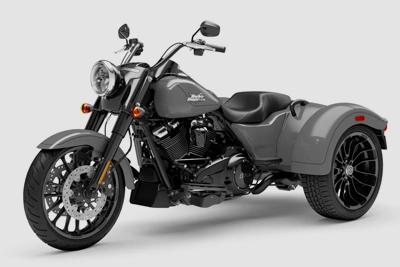
The Freewheeler needs a clear introduction: it is a motorcycle trike, not a car. You steer with handlebars and sit astride it, with one wheel at the front and two at the rear. That makes it quite a different proposition from a Morgan or Slingshot.
For a specific reference point, the 2025 Freewheeler uses Harley-Davidson’s Milwaukee-Eight 114 V-twin. The manufacturer lists 90 hp, 119 lb-ft of torque and two cubic feet of luggage capacity.
The upright riding position, footboards and lockable rear storage give it a relaxed touring flavour. It belongs here as a useful comparison for readers exploring three-wheel transport, although anyone wanting a steering wheel and side-by-side seats should concentrate on the roadsters instead.
3. Campagna T-Rex RR: Small Cockpit, Serious Intent
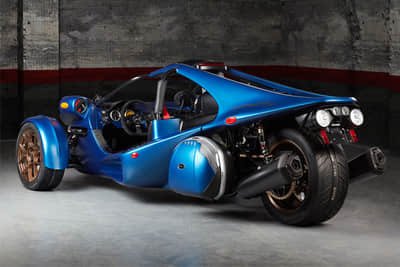
The Canadian T-Rex has never been especially interested in blending in. Its low seats, exposed front wheels and compact bodywork give it the appearance of something built around the driver, with very little left over.
There have been different T-Rex versions, so the engine details matter. The older BMW-powered model should not be confused with the 2026 T-Rex RR. Campagna lists a 1,441 cc four-cylinder engine producing 208 hp, a weight of 498 kg and a claimed 0–60 mph time of 3.9 seconds for that version.
Those figures explain why this is more than a quirky shape. The RR is aimed at enthusiasts who want a strong sense of speed and mechanical involvement. Getting comfortable in its low cockpit, and understanding its controls and handling, deserves rather more attention than choosing a paint colour.
4. Polaris Slingshot: The One That Looks Like a Decepticon
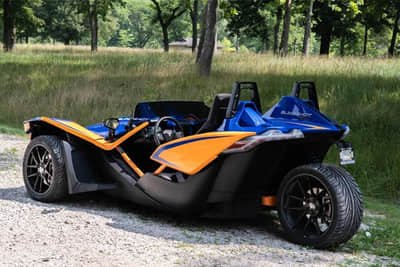
The Slingshot still looks almost like a Decepticon. That sharp nose, broad front end and single rear wheel make it one of the easiest three-wheelers to recognise. There is a steering wheel, foot pedals and side-by-side seating, so the basic layout feels more familiar to a car driver than the Harley’s does.
The original article’s 2.4-litre GM engine describes an earlier Slingshot. Polaris’s 2026 model announcement specifies a 2.0-litre ProStar four-cylinder engine, with manual and AutoDrive transmission options. Power and equipment vary by trim.
If you enjoy unusual car designs, there is plenty to admire here. Just remember that familiar controls do not make it equivalent to a passenger car: Polaris identifies the Slingshot as a three-wheeled motorcycle and states that it does not meet automotive safety standards.
A Kit-Built Three-Wheeler and Two Classic Microcars
5. MEV tR1ke: For the Hands-On Enthusiast

The MEV tR1ke takes the stripped-back idea rather literally. Its exposed structure and motorcycle-powered layout are a long way from a neatly trimmed modern roadster. For someone who enjoys understanding how a machine goes together, that can be much of the attraction.
MEV’s description of the tR1ke identifies a Yamaha R1-engined design and notes that a Suzuki version was also available. There is no single horsepower figure that can fairly describe every completed example.
MEV also flags the skill required to drive it and the effect of an absent passenger on balance when turning left. That is a useful reminder that a kit build needs to be judged as an individual vehicle.
Before buying one, establish the actual engine specification, build quality, registration history and inspection requirements. A claimed power figure is no substitute for knowing who assembled it and how well the work was done. Confirm parts and kit availability directly rather than assuming an older model page means new kits are in stock.
6. Allard Clipper: A Very Different Kind of Allard

Allard is better known for muscular sports cars, which makes the tiny Clipper quite a surprise. This 1950s microcar took the company into a very different corner of motoring, with a small engine and a fibreglass body instead of the performance-car ingredients enthusiasts usually associate with the name.
The Allard Register’s account of the Clipper describes a design by David Gottlieb, with Allard contracted to produce the prototype chassis. Body-production difficulties and mechanical problems complicated the project, and only a very small number were built.
Its appeal today is the story as much as the shape. This was a small manufacturer trying something different, and the surviving cars preserve that effort. It is a fascinating collector’s piece, although rarity alone does not make a car straightforward to own or restore.
7. BMW Isetta: The Bubble Car, With One Important Detail
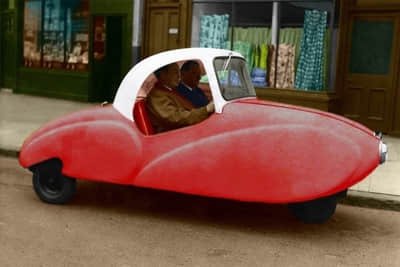
The Isetta is perhaps the most recognisable little bubble car of all. Its rounded body and front-opening door have a charm that photographs still capture beautifully. It looks friendly before it has even moved.
But not every Isetta belongs on a list of three-wheeled cars. Many had four wheels, with the rear pair positioned close together. The National Motor Museum’s Isetta history explains that three-wheel versions were sold in the UK, where the arrangement brought licensing and road-tax advantages at the time.
The museum’s British-built 1962 Isetta 300 has a 298 cc single-cylinder engine and a listed output of 13 hp. That gives you a better idea of its purpose than any suggestion of sports-car performance. This was small-scale, economical transport.
Among cute small cars, the Isetta has a personality all its own. If you are viewing one for sale, check the actual wheel arrangement rather than relying on the model name or a flattering front photograph.
Three-Wheeled Concepts That Took a Different Road
8. Volkswagen GX3: The Roadster That Never Reached Showrooms

Volkswagen’s GX3 was one of those concepts that made the production-car question feel especially tempting. Unveiled in 2006, it paired two front wheels and a single rear wheel with a low, open two-seat body. It was hardly the sensible hatchback people expected from Volkswagen.
In its contemporary GX3 test drive, Automobile reported Volkswagen’s proposed 1.6-litre four-cylinder specification and claimed 0–62 mph time of 5.7 seconds. Those were project targets, not specifications for a showroom model.
The GX3 did not enter commercial production. Its place here is as an intriguing automotive “what if”, rather than an affordable used Volkswagen you can realistically put on a shopping list.
9. Honda 3R-C: A Tiny Electric Commuter Idea

Honda’s 3R-C looked at three wheels from a different angle. Instead of an open-road toy for two, it proposed a compact electric vehicle for one person making short urban journeys.
Honda presented the 3R-C at Geneva in 2010. Its battery-electric drivetrain sat low in the chassis, and the transparent canopy covered the seat when parked. During driving, that canopy became a windscreen in front of the occupant.
That little transformation is what makes the design memorable. It tried to give a minimal commuter some protection without turning it into a full-sized enclosed car. The 3R-C remained a concept; it was not a production Honda with a confirmed retail price or customer range figure.
10. Mercedes-Benz F 300 Life Jet: The One That Leaned

The Mercedes-Benz F 300 Life Jet asked an entertaining question: could a three-wheeled vehicle lean into a bend and bring some of a motorcycle’s cornering sensation to a car-like cockpit?
Introduced in 1997, the F 300 used active tilt control to explore that idea. Mercedes-Benz’s research-vehicle history identifies it as an experiment in combining car comfort with motorcycle-like dynamics.
Its tandem seating placed the passenger behind the driver, rather than alongside. Between that narrow shape and the tilting body, it was quite different from simply removing a wheel from an ordinary car.
The F 300 Life Jet was a research vehicle, not a production Mercedes. Its interest lies in the engineering question it explored, rather than whether you could order one from a dealer.
What Should You Know Before Buying a Three-Wheeler?
A three-wheeler can be a wonderful enthusiast purchase, but the practical details deserve a little less romance. Start with the exact vehicle, not the broad category.
- Check its identity and legal category. A motorcycle trike, an autocycle, a historic microcar and an individually built kit vehicle can have different requirements. Verify registration, licence and helmet rules with the relevant authority where you will use it.
- Understand the protection it provides. A steering wheel and seat belts do not establish passenger-car crash protection. Polaris’s Slingshot ownership information, for example, explicitly states that it has no airbags and does not meet automotive safety standards.
- Try the seating and access. Low cockpits, exposed cabins and limited luggage room can be more noticeable in daily use than they are in photographs. Consider weather protection and where you will store it.
- Investigate support before paying. Find out who can service it, whether parts are available and what insurance will cost for your location and intended use.
- Inspect classics and kit builds carefully. Documentation, previous repairs and specialist assessment matter. The same care involved in buying a classic car is particularly useful when an unusual vehicle has a small support network.
Common Questions About 3-Wheeled Cars
“Three-wheeler” is the broad everyday term. Depending on its construction and local rules, a particular vehicle may be registered as a motor tricycle, motorcycle, autocycle or another category. “Autocycle” is not a universal name for every three-wheeled vehicle.
Yes. The Morgan Super 3, Polaris Slingshot and Campagna T-Rex RR are production examples, subject to market availability and local approval. Classic Isettas and completed kit builds may also appear for sale. The Volkswagen GX3, Honda 3R-C and Mercedes-Benz F 300 Life Jet discussed here were not commercially produced models.
There is no single safety verdict for the whole category. Handling and occupant protection depend on the design, equipment, condition and use of the vehicle. Do not assume that three wheels guarantee motorcycle agility or passenger-car protection. Read the model’s safety information and seek appropriate familiarisation before driving it.
There is no useful category-wide price. New roadsters, rare restored microcars and used kit builds sit in different markets. Compare an actual dealer quotation or documented asking price, then add taxes, delivery, registration, insurance and any repairs. An old concept’s proposed launch price is not a buying guide.