

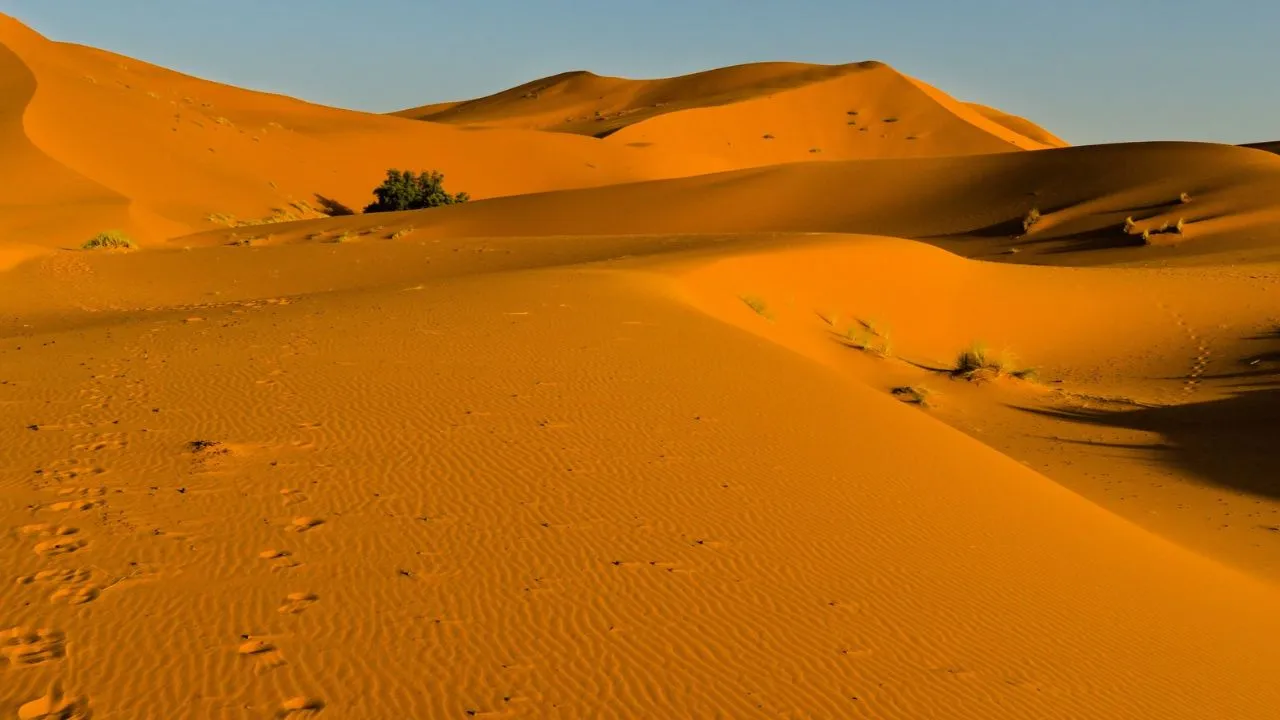
We’ve all read about the Sahara Desert in school books. A whole lot of sand, scorching sunshine and the occasional camel. Big deal, right?
Actually, yes. It is a very big deal.
The Sahara is the largest hot desert in the world, stretching across much of North Africa. But it isn’t simply an endless sea of sand. There are rocky mountains, ancient riverbeds, salt flats, oases and communities that have learned to live in one of the driest environments on Earth. And some of the most surprising things about the Sahara have little to do with sand at all.
How Big Is the Sahara Desert?
The Sahara Desert covers approximately 9.2 million square kilometres (3.6 million square miles). That makes it the world’s largest hot desert and the third-largest desert overall, after Antarctica and the Arctic. Its precise area varies with how its boundaries are defined, particularly along the Sahel to the south.
To picture that size, imagine a region almost as large as the United States. The Sahara stretches roughly 4,800 kilometres (3,000 miles) from west to east. It occupies a remarkable portion of northern Africa, yet the landscape changes considerably as you cross it.
It is easy to assume that all that space must be covered in dunes. Surprisingly, vast areas are bare rock, gravel plains and mountains. Sand seas cover only about a quarter of the desert. So yes, the Sahara is enormous, but it is far more varied than the familiar postcard photograph suggests.
Where Is the Sahara Desert Located?
The Sahara lies across North Africa, between the Mediterranean region to the north and the Sahel, a belt of semi-arid land, to the south. The Atlantic Ocean lies to the west, while the desert extends towards the Red Sea in the east.
It reaches across parts of Algeria, Chad, Egypt, Libya, Mali, Mauritania, Morocco, Niger, Sudan and Tunisia, as well as Western Sahara, whose political status is disputed.
Because it is so large, the Sahara has no single landscape or climate experience. Conditions in an oasis settlement can be very different from those on an exposed plateau or deep among the dunes.
What Does the Sahara Desert Look Like?
Golden dunes are certainly part of the picture. Some rise like waves, with sharp ridges that seem to go on forever. Yet you could travel across huge stretches of the Sahara without seeing those famous sand mountains at all.
Sand Dunes and Rocky Plains
Large dune fields are called ergs. Wind shapes the sand into different patterns, from long ridges to crescent-shaped dunes and towering star dunes. Elsewhere, broad rocky plateaus and gravel-covered plains dominate the ground.
NASA’s satellite observations show just how varied these dune landscapes can be. In parts of Algeria, winds blowing from different directions help form distinctive star-shaped dunes. NASA’s images of Saharan dunes offer a particularly good look at the patterns.
Mountains, Volcanoes and Depressions
The Sahara also contains rugged highlands. Emi Koussi, an extinct volcanic peak in Chad’s Tibesti Mountains, rises to around 3,445 metres (11,300 feet), making it the Sahara’s highest point. At the other extreme, Egypt’s Qattara Depression drops well below sea level.
There are dry valleys, salt flats and ancient watercourses too. The Nile crosses the eastern Sahara, while underground aquifers supply water to many settlements and oases. It would be misleading, though, to say the Nile is the desert’s only water source.
Compared with the other major deserts around the world, the Sahara stands out not only for its size but also for the sheer variety of its terrain.
What Is the Climate Like in the Sahara Desert?
Hot, dry and often unforgiving. That is the simplest description, but it misses a few interesting details.
Many parts of the Sahara receive very little rain, and some central areas may go years without significant rainfall. Summer daytime temperatures can climb above 45°C (113°F) in particularly hot locations. But there is no single temperature that describes the whole desert: altitude, season, latitude and time of day all matter.
Nights can be surprisingly chilly, especially in winter and at higher elevations. With little moisture and often few clouds to hold in warmth, heat escapes quickly after sunset. In some places, temperatures can even fall below freezing.
Wind is another part of Saharan life. Dust and sandstorms can reduce visibility and disrupt travel. Fine Saharan dust may travel far beyond Africa, crossing the Atlantic on atmospheric winds.
Was the Sahara Once Green?
Here is something that sounds almost impossible when you look at today’s landscape: the Sahara has not always been this dry.
During earlier humid periods, parts of North Africa supported lakes, rivers, grasslands and much more vegetation than they do now. One relatively recent wet phase, often called the African Humid Period, followed the end of the last ice age and gradually gave way to drier conditions several thousand years ago.
Changes in Earth’s orbit helped alter the strength and reach of the African monsoon. The story is more complicated than a desert simply turning green every 20,000 years on a fixed schedule, however. Vegetation, oceans and atmospheric feedbacks also influenced how wet the region became. Research on these changes is discussed in Nature Education’s explanation of the Green Sahara.
So the Sahara has a much wetter past. Whether, when and how far it might become greener again cannot be reduced to an exact date.
What Animals Live in the Sahara Desert?
Camels are the animals most people associate with the Sahara, and for good reason. Dromedaries have long helped people transport goods and travel across dry landscapes. But they are domestic animals, and the desert’s wild creatures are much more varied.
Fennec foxes, with their famously large ears, are among the best-known Saharan mammals. There are also addax antelopes, dorcas gazelles, small rodents, desert-adapted reptiles, scorpions and many insects. Some species, including the Saharan cheetah, are extremely rare and face serious conservation threats.
Many desert animals avoid the hottest part of the day. They rest in burrows or sheltered places and become more active at night. Others obtain much of the moisture they need from food, rather than relying on frequent access to open water.
And no, you will not see every one of these animals on a desert excursion. Wildlife can be difficult to spot, especially in a landscape this vast.
What Plants Grow in the Sahara Desert?
Plant life can look sparse, but it has some clever ways of surviving.
Acacia trees, tamarisks, hardy grasses and drought-resistant shrubs grow in suitable parts of the desert. Date palms are especially important around oases, where access to water makes cultivation possible. Some plants develop deep roots, while others have tiny leaves or other features that help reduce moisture loss.
After rain, seeds that have been lying dormant may germinate quickly. For a short time, patches of otherwise bare ground can turn green or produce flowers. It is a lovely reminder that a desert is not necessarily lifeless.
One old piece of desert advice is worth ignoring: do not assume that a cactus or an unfamiliar wild plant is safe to eat for water. Some plants are harmful, and many familiar cacti are native to the Americas rather than the Sahara. Safe drinking water should always be planned in advance.
Who Lives in the Sahara Desert?
It is tempting to picture the Sahara as completely empty. It isn’t. People have lived in and travelled through the region for thousands of years, building communities around oases, trade routes and places where water is available.
The Sahara is home to a range of peoples and cultures, including Tuareg and other Amazigh communities, Arab communities and many others. Languages, livelihoods and traditions differ greatly across the region. It would be wrong to describe everyone who lives there as a nomad.
Some families have traditionally moved with their livestock, while others live in towns, cities and oasis settlements. Farming, trade, transport, mining, services and tourism all contribute to local economies, although opportunities and conditions vary from place to place.
For centuries, trans-Saharan routes connected communities across North and West Africa. Traders carried salt, gold and other goods, and the routes also helped ideas, languages and knowledge move between regions. The Sahara was a difficult crossing, but never simply an empty barrier between people.
What Can Visitors Do in the Sahara Desert?
Visiting the Sahara can be extraordinary. Just remember that it is not one destination with one set of activities. What is possible depends on the country, the season, local conditions and the specific area you plan to visit.
- Walk among the dunes: See the shapes, colours and shadows change as the sun moves across the sand.
- Take a guided camel excursion: Learn about the animal’s longstanding role in desert travel, using operators that treat animals responsibly.
- Try sandboarding: Some dune destinations offer it, though conditions and access vary.
- Visit an oasis or historic settlement: These places reveal how communities have managed water and daily life in arid surroundings.
- Camp and watch the night sky: Remote areas can offer remarkable stargazing when skies are clear and light pollution is low.
- Explore desert geology and history: Guided visits may reveal ancient rock art, unusual formations and traces of earlier environments.
Quad biking and other motorised activities are available in some tourist areas, but they can disturb fragile habitats and are not appropriate everywhere. A local guide, a sensible route and respect for the environment matter more than trying to squeeze every activity into one trip.
And although desert travel can be peaceful, it is not automatically a safe or relaxing escape. Anyone considering the Sahara among their relaxation travel destinations should check current travel advice, weather, water supplies, transport arrangements and the suitability of the particular region.
Is the Sahara Desert Getting Bigger?
Researchers have found evidence that the Sahara’s boundaries have shifted over time. A study published in the Journal of Climate estimated that the desert expanded by about 10% between 1920 and 2013 when measured using annual rainfall. That does not mean it grew by 10% in just a few recent years.
The study linked the changes to a combination of natural climate variability and human-influenced climate change. The estimated rate depends on how the desert is defined and which years are compared, so a single percentage should not be treated as a simple prediction of what happens next. The University of Maryland’s summary of the research explains the findings.
Changes in rainfall and land conditions matter for the communities and ecosystems near the desert’s edges. But the claim that the Sahara is about to swallow the entire African continent is not supported by this research.
Interesting Facts About the Sahara Desert
The more you learn about the Sahara, the harder it becomes to think of it as nothing but sand. Here are a few details that tend to surprise people.
1. It Is the Largest Hot Desert, Not the Largest Desert Overall
Antarctica and the Arctic are also deserts because they receive very little precipitation. Both are larger than the Sahara. The Sahara holds the record among hot deserts.
2. Most of the Sahara Is Not Covered in Sand Dunes
Rock, gravel, mountains and other landforms make up much of its surface. The great sand seas are spectacular, but they are only part of the landscape.
3. Parts of the Sahara Were Once Much Wetter
Ancient lakebeds, sediments and rock art help tell the story of earlier periods when water and vegetation were more widespread.
4. Flowers Can Appear After Rain
Some desert plants complete much of their visible growth during short periods of moisture. A place that seemed bare can briefly look very different.
5. Snow Can Fall in the Sahara
It is uncommon in most low-lying desert areas, but snow has been observed in parts of the Sahara, particularly in elevated or unusually cold conditions. Desert does not always mean permanently hot.
6. The Sahara Contains Ancient Rock Art
Prehistoric images of people and animals survive in places such as Tassili n’Ajjer in Algeria. They provide glimpses of the region’s human history and changing environments.
7. Its Dust Travels Across Oceans
Fine particles lifted by Saharan winds can cross the Atlantic. Some of that dust eventually settles far from the desert where it began.
8. The Sahara Has Oases Fed by Underground Water
Not all desert water is visible at the surface. Aquifers have supported settlements and agriculture, although groundwater use needs careful management.
Frequently Asked Questions About the Sahara Desert
It covers approximately 3.6 million square miles, or 9.2 million square kilometres. Estimates vary slightly depending on where its boundaries are drawn.
It is the world’s largest hot desert. Antarctica is the largest desert overall, followed by the Arctic.
The Sahara is in Africa, stretching across much of the continent’s northern region.
No. Sand seas cover roughly a quarter of the Sahara. Rocky plains, gravel, mountains, dry valleys and salt flats occupy much of the rest.
Summer daytime air temperatures in some areas can exceed 45°C (113°F), but conditions vary widely by place and season. Winter nights, especially at higher elevations, can be very cold.
Yes. The Sahara contains towns, oasis communities and mobile pastoral populations, with many different languages, cultures and livelihoods.
Yes, although rainfall is scarce and highly uneven. Some areas receive occasional rain, while parts of the central desert can remain dry for long periods.
Yes. Snowfall is rare in much of the desert, but it has occurred in certain areas during unusually cold weather and at higher elevations.
Parts of the Sahara were much wetter during past humid periods, supporting lakes, rivers and vegetation. Changes in Earth’s orbit and the African monsoon helped drive these shifts.
It has shaped African history, trade, settlement and culture. Its ecosystems support specialised wildlife, while its dust, climate and changing rainfall patterns also affect places far beyond the desert itself.
A Desert With More Stories Than Sand
The Sahara can seem simple from a distance: heat, dunes and a horizon that never ends. Look a little closer, though, and the picture changes. There are mountains where you expected sand, traces of ancient lakes where you expected nothing but dryness, and communities whose histories stretch back through centuries of travel and trade.
Perhaps that is what makes the Sahara so fascinating. It is not merely the size of the place, impressive as that is. It is how much life, history and change can exist in a landscape that first appears so empty.